2026-03-25
Why Neapolitan Pizza and American Pizza Are Basically Different Foods
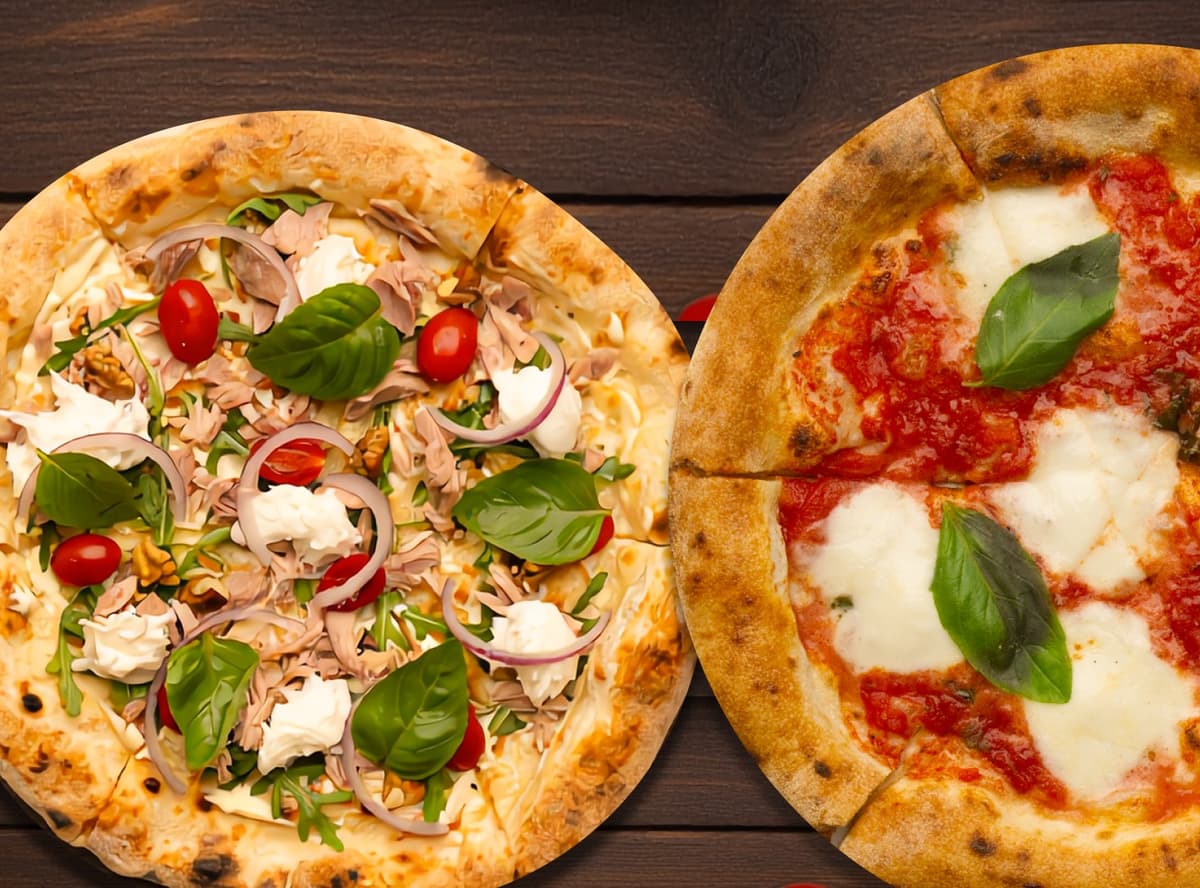
Order a "pizza" in Baku and you could get two completely different things. One arrives puffed at the edges, soft enough to fold, slightly charred, and gone in a few quick bites. The other comes thick, heavy, loaded with cheese, and sits in your stomach like a second dinner.
They share a name. They share almost nothing else.
People argue about which pizza is "better," but that's the wrong question. Neapolitan pizza and American pizza aren't two versions of the same dish — they're two different foods that happen to use flour, tomato, and cheese. Once you understand why they're different, the choice becomes obvious.
It starts with the dough — and the patience
Real Neapolitan dough is made from four ingredients: flour, water, salt, and yeast. That's it. No sugar, no oil, no milk powder, no dough conditioners. The magic isn't in what goes in — it's in time.
A proper Neapolitan dough ferments slowly, often for 24 to 72 hours. That long, cold rise does two things: it builds a deep, almost yeasty flavor you can't fake, and it breaks down the dough so it's lighter and far easier to digest. This is why you can eat an entire Neapolitan pizza and still feel fine an hour later.
American pizza dough — especially the kind from big chains — is usually built for speed and volume. It often contains sugar and oil for a softer, sweeter, more bread-like result, and it's frequently made the same day. The goal is consistency and shelf life, not fermentation flavor. It's engineered to taste the same in every city, every time.
That's not an insult. It's just a different goal. One dough is crafted; the other is manufactured.
The oven changes everything
Here's the difference most people never think about: heat.
A Neapolitan pizza is baked in a stone or wood-fired oven at around 450°C. At that temperature, the pizza is done in about 90 seconds. The intense heat blisters the crust, creates those signature charred "leopard spots," and locks in moisture before the dough can dry out. The result is a crust that's soft and airy inside, slightly crisp outside, and never tough.
American pizza is usually baked in a conveyor or deck oven at a much lower temperature — roughly 250 to 300°C — for 10 to 20 minutes. That slow bake dries the dough into something sturdier and crunchier, almost like a thick cracker or a soft bread base depending on the style. It has to be that strong, because it's carrying a heavy load.
Ninety seconds versus twenty minutes. That single number explains why these two pizzas feel nothing alike when you bite into them.
One is built around toppings. The other is built around dough.
This is the philosophical split.
In Naples, the pizza is the dough. Toppings are restrained on purpose — a classic Margherita is just San Marzano tomato, fresh mozzarella (Fior di Latte), basil, and a thread of olive oil. The point isn't to pile things on; it's to let the crust, the tomato, and the cheese each taste like themselves. Less is the entire idea.
American pizza flips the logic. The dough is mostly a vehicle — a sturdy platform engineered to hold as much as possible. More cheese, more meat, more sauce, stuffed crusts, double pepperoni. The experience is about abundance. It's comfort food in its most generous, maximalist form.
Both have their place. But if you've only ever had the loaded version, you've never actually tasted what pizza was originally meant to be: a balance, not a pile.
Even the cheese is a different ingredient
American pizza usually uses low-moisture, processed mozzarella. It's designed to melt into a thick, stretchy, golden blanket and to survive heavy handling and long bakes. It does that job perfectly.
Neapolitan pizza uses fresh Fior di Latte — soft, milky, high-moisture mozzarella that melts into delicate white pools rather than a solid sheet. It tastes like fresh milk because it basically is. You'd never load a pizza with it the way a chain does; it would flood the base. It's used sparingly, and that restraint is the point.
Same word — "mozzarella." Two completely different ingredients.
How you eat it tells the whole story
A Neapolitan pizza has a soft, slightly wet center by design. In Naples, people fold a personal pizza into quarters — the libretto, or "little book" — and eat it on the move. It's meant to be eaten fresh, fast, and hot, ideally within minutes of leaving the oven. That softness isn't a flaw; it's the signature.
American pizza is built to be picked up by the slice, held flat, folded lengthwise, reheated the next morning, and shared from a giant box. Its sturdiness is a feature. It's social, durable, and forgiving.
These aren't just two recipes. They're two entirely different relationships with food.
So which one is "real" pizza?
Both are real. But only one is the original.
Pizza was born in Naples as fast, honest street food — a few simple ingredients, blistered in a roaring oven in under two minutes, eaten on the spot. Everything that came after, including every American style, is an interpretation of that idea. Some interpretations wandered very far from home.
At Celentano, we make pizza the original way: hand-kneaded dough, a 450°C stone oven, a 90-second bake, and real Fior di Latte mozzarella. Not because the American version is wrong — but because most people in Baku have never tasted the real thing. And once you do, you understand why Naples never needed to change it.
Curious what 90 seconds at 450°C actually tastes like? Order a real Neapolitan pizza and taste the difference for yourself — delivered hot, across Baku.